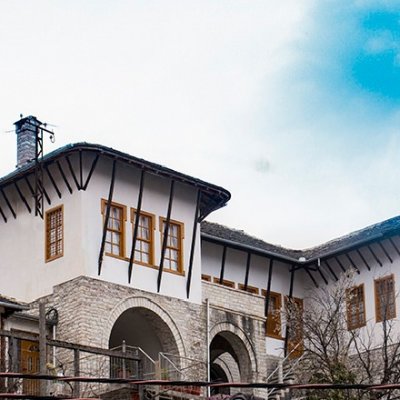
Ismail Kadare's House Gjirokaster
Rruga Fato Berberi 16
Gjirokaster Gjirokastër County
Albania
www.visit-gjirokastra.com/dt_places/ismail-kadare-house/
17:00
17:00
17:00
17:00
17:00
17:00
17:00
Are you the owner of this business?
Suggest an edit
Museum


Ismail Kadare's House Gjirokaster
DETAILS
Ismail kadare house (Area)
This is the house where Ismail Kadare was born and spent his childhood. The house was first built in 1799, and classified as a Cultural Monument in 1991. “House Kadare” is familiar to everyone who has read his book “Chronicle in Stone”, in which Kadare describes every corner of this house.
Ismail kadare (Point)
Ismail Kadare is an Albanian novelist, poet, essayist, screenwriter and playwright. He is a leading albanian literary figure and an international intellectual. He was born is Gjirokastra on January 28, 1936.
Hard times for the u... ... (Area)
No doubt about it, these were hard times for the upper floors of the city. When it was built, the wood had cunningly had itself hoisted up top, leaving the stone to the foundations, cellars and cisterns. Down there in the half-darkness, the stone had to fight the rising damp and the groundwater, while the wood, nicely carved and carefully tended, adorned the upper floors. These were light, almost ethereal: the city seemed to have changed its mind, and hurried to rectify the error. It had them covered with roofs of slate, as if to establish once and for all that here stone was king.
English bombing as a... ... (Point)
The English planes paid us regular visits every day. They would loom in the sky almost to a schedule, and people seemed to get used to the bombings as a disagreeable part of a daily routine. “See you tomorrow at the coffee house, right after the bombing.” “I’ll be up at dawn tomorrow; that way I think I’ll have the house cleaned before the bombing.” “Come on, let’s go down to the cellar, it’s almost time.”
Living room (Area)
This main living room had six big fine windows as tall as my father, and a grainy, mottled ceiling of carved wood. A lot of housekeeping went on in this room. My mother would wash and scrub the floorboards until they shone like wax. The curtains on the windows were white with lace borders, and the room was ringed by low wooden ledges covered with thin mattresses, where old women would sit when they came to visit, sipping the coffee and making sage pronouncements. It was easy to see why the other rooms, even the hallway, were jealous of the main room.
Cinema ii (Area)
To be honest, the places in the city where you could see anything of interest could be counted on the fingers of one hand. Apart from the movies, which were seen by children and the frivolous, there were two places you might get to see a fight usually on Sundays: the gypsy district and the square behind the mosque, where the porters divided up their earnings.
Welcome (Area)
An open invitation to travel back in time. This house is symbolic of Ismail Kadare’s childhood and literary work, simultaneously a pearl of cultural and architectural values. This beautiful Ottoman-style house dates back to 1779, although it was rebuilt after an accidental fire in 1999. The restoration has fully adhered to the original project of the building - with two habitable floors and the ground floor pantry, which served to keep food reserves but also as a shelter during bombings in the Second World War. What distinguishes it from other traditional houses of Gjirokastra is the presence of some unique elements: stairs that start inside and go outside the house, to climb to the floors above; transparency within the walls of the central part of the apartment and the height of 5 meters of the first floor, all covered with a vault. Even inside the Kadare house, there are elements that determine its value, such as carved eaves, ceilings and doors with some of the most interesting motifs.
(Point)
Tomorrow we were going to the citadel. We would say good-bye to the steps, doors and windows of our house, leave the familiar words behind and enter the unknown. Everything there would be magical, terrifying and extraordinary. -Come here, let me kiss you, grandmother said. I stood there dumbfounded. -Why, aren't you coming with us? -No, I'm staying here. I won't leave the house all on its own, she said calmly. This is where I've spent my life, and this is where I want to die. Another knock. Bless you all, said grandmother, kissing each of us in turn.
(Point)
‘’Don't be scared’’, she replied. Neighbours will come to help with bailing out, and the cistern will calm dow. Her voice became rhythmical, as, if she was whispering an old tale: ‘’In this world, each ill has its cure. Only death, my dear boy, has no remedy.’’
(Point)
The Italians came back to the city. In the morning the road was filled with mules, guns and endless columns of soldiers. The Greek flag with its white cross was taken down from the prison tower, giving way to the Italian tricolour with its fascist insignia. It was soon obvious that this was not just another passing occupation. The siren, the searchlight, the anti-aircraft battery, the nuns and the prostitutes all followed the soldiers in.
(Point)
The two grandmothers went into the main room and sat facing one another on the divans.. -My daughter, our visitor said through her sobs and tears, my youngest has run off to be a partisan. …-Get hold of yourself, said grandmother. I was wondering what on earth it could be. -But look, she’s with friends. -She’s gone, and crying won’t bring her back. Let’s just hope she comes back one day safe and sound. -But what about the family’s honour, Selfixhe? She moaned. What will people say? -Her honour will depend on the honour her comrades win. Make us some coffee, my child.
(Point)
Grandmother picked up the carcass, squinted, and stared hard at it, turning it this way and that, holding one side and then the other up to the light. We all waited in silence. "War", Grandmother said suddenly in a muffled voice. "The edges of the carina are red. War and blood? She pointed to the places on the breastbone that foretold war. No one spoke. Grandmother kept looking at the bone. "War," she repeated, putting her left hand on my head as if to protect me from some scourge.
(Point)
Grandmother and Aunt Xhemo, with their cracked glasses perched on their noses, were keeping watch over the road from their respective windows, waiting to catch a glimpse of the men with yellow hair. Clues had been perceptible for some time. Now the signs were unmistakable: Grandmother and Aunt Xhemo were getting ready to turn into crones. The German invasion seemed to be the definitive test for them, as the great incursions of the Turks, the massacres on the ruins of the republic and the monarchy, and the forty years of constant hunger had been for other crones.
Dreaming (Point)
I couldn’t go to sleep. The book lay nearby. Silent. A thin object on the divan. It was so strange…Between two cardboard covers were noises, doors, howls, horses, people. All side by side, pressed tightly against one another. Decomposed into little black marks. Hair, eyes, legs and hands, voices, nails, beards, knocks on doors, walls, blood, the sound of horseshoes, shouts. All docile, blindly obedient to the little black marks. The letters run in mad haste, now here, now there. The h’s r’s, o’s, t’s gallop over the page. They gather together to create a horse or a hailstorm. Then gallop away again. Now they create a dagger, a night, a ghost. Then streets, slamming doors, silence. Running and running. Never stopping. Without end.
Imagine the characte... ... (Point)
Imagine and draw the characters described by Ismail Kadare in his book “Chronicle in stone”. Grandmother, Kako Pino, Dino Çiço, Javer, Ilir -How can we lower the water, grandmother? -With buckets, dear boy. I went to the opening and looked down. Darkness. Darkness and a feeling of terror. -Aoo, i said softly. But the cistern didn’t answer. It was the first time it had refused to answer me. I like the cistern a lot and often leaned over its rim and had long talks with it. It had always been quick to answer me in its deep, cavernous voice. -Aoo, i said again, but still it was silent. I thought it must have been very angry.
Realm of fantasy (Point)
A neighbour he sees as Lady Macbeth; a cabbage in the market takes on the form of a severed head. Passing troops become Crusaders until he and his friends grow up to join a band of partisans, and the world of childhood fantasy finally gives way to that of our often savage maturity.
Imagining the city (Point)
“It was a strange city, and seemed to have been cast up in the valley one winter’s night like some prehistoric creature that was now clawing its way up the mountainside. Everything in the city was old and made of stone, from the streets and fountains to the roofs of the sprawling age-old houses covered grey slates like gigantic scales. It was hard to believe that under this powerful carapace the tender flesh of life survived and reproduced.”
More tours nearby
Gjirokastër Museum
Muzeu i Armëve
Bazar Mosque
Zekate House
Babameto House
Rruga Sokaku i te Mareve
Rruga Sokaku i te Mareve